Blog · AI
Meta's Muse Spark Open brings large-scale AI to Mac Studio
Meta introduces Muse Spark Open, bringing large-scale AI to Apple’s Mac Studio. Meta has taken another step toward making powerful artificial intelligence more accessible to developers.
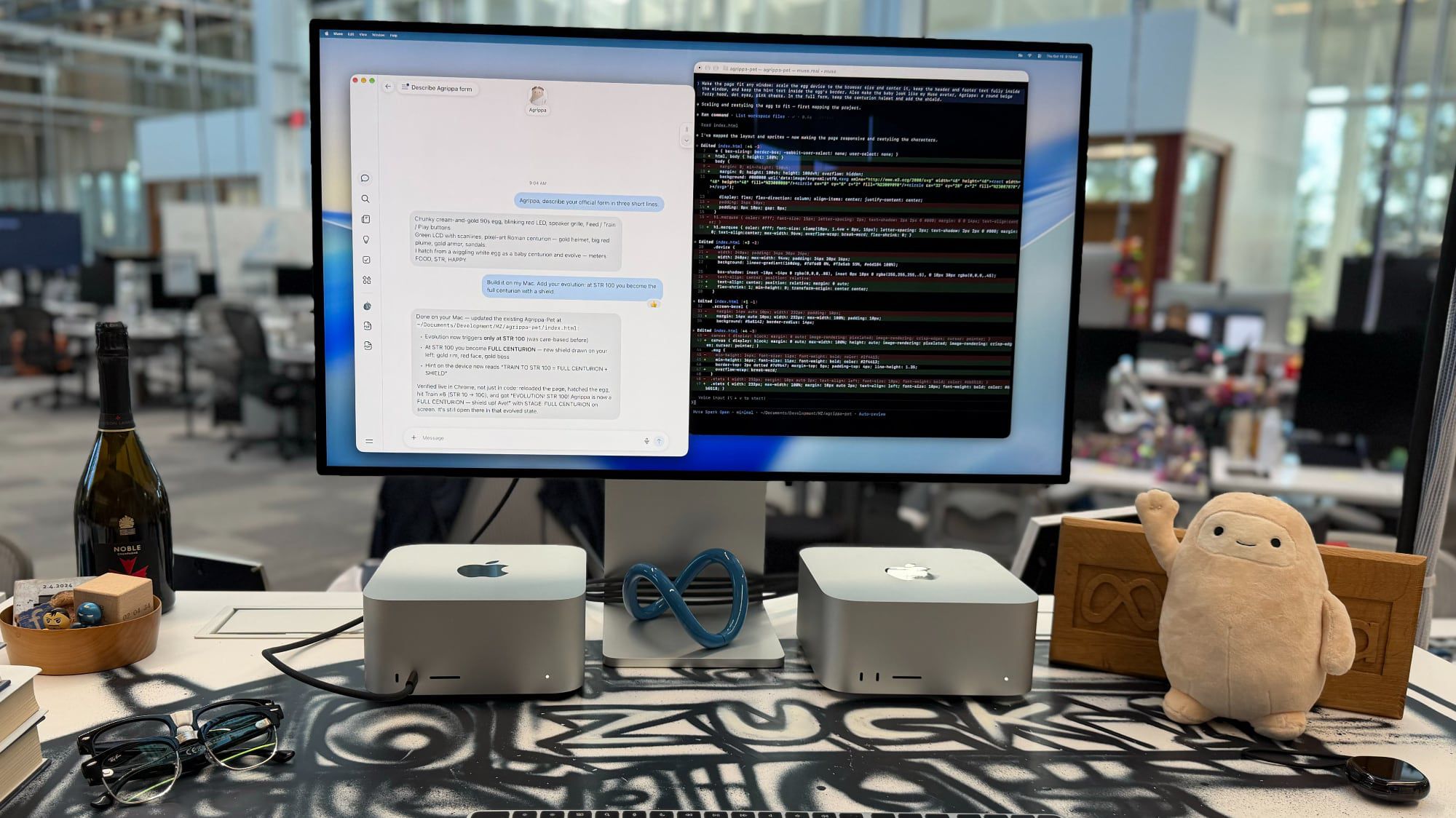
Meta introduces Muse Spark Open on October 15, 2026. An open weights AI model that bringing large-scale AI to Apple’s Mac Studio.
Meta has taken another step toward making powerful artificial intelligence more accessible to developers with the release of Muse Spark’s open weights on October 15, 2026. The model is designed to support advanced AI applications, including local deployment on Apple’s M5 Ultra Mac Studio hardware.
With 816 billion total parameters and approximately 42 billion active parameters per token, Muse Spark is built to handle demanding workloads such as software development, complex reasoning, and multi-step tasks. It supports text, images, audio, and video, with a context window of up to one million tokens.
Running a Large AI Model on Apple Hardware
One of the most interesting aspects of the release is its collaboration with Apple. By using Apple's MLX framework, developers can run the model across two M5 Ultra Mac Studio systems. This gives researchers and developers another way to experiment with large AI models without relying entirely on traditional data center infrastructure.
More Options for Developers
The model weights are available through several platforms, including Hugging Face, Amazon SageMaker AI, Google Cloud Model Garden, and Microsoft Foundry. Developers can also access the model through selected AI inference providers.
Those looking to customize or optimize their deployment can explore tools such as PyTorch TorchTitan, along with inference engines including SGLang and vLLM. These options give development teams greater flexibility when testing the model and integrating it into their own projects.
A Further Step Toward Open-Weight AI
The release follows Meta's introduction of a closed version of Muse Spark in April 2026 and a subsequent version 1.3 update in August. Making the model weights available represents another move toward giving developers more freedom to study, experiment with, and adapt AI technology.
Open-weight models can provide developers with more control over how AI systems are deployed and customized. However, access to model weights does not automatically mean that every part of a model's training process, data, or underlying technology is open.
Could Local AI Become More Practical?
Beyond the technical specifications, the announcement reflects a broader shift in AI development. Rather than depending entirely on cloud-based services, some developers may be able to run increasingly capable models on their own hardware.
Local deployment can offer greater control over infrastructure and data handling, and may reduce reliance on external AI services. The actual benefits, however, depend on hardware costs, memory requirements, performance, and the needs of each application.
What This Means for Meta and Apple
For Meta, the release strengthens its presence in the open-weight AI ecosystem and gives developers another model to explore. For Apple, the collaboration highlights the potential of high-memory desktop systems for demanding AI workloads.
The key question is whether running large AI models locally will become practical for a broader range of users. As hardware and software continue to evolve, desktop-based AI could become a more attractive option for coding assistants, autonomous agents, and applications that require complex, multi-step reasoning.
While challenges around cost, performance, and accessibility remain, Muse Spark's open-weight release adds another development to the ongoing effort to make advanced AI more flexible and accessible to developers.